

Quickstart#
jaxoplanet is a Python package to model the unresolved light received from stellar and planetary systems. It implements most of the features from the exoplanet and starry packages built on top of JAX, allowing for hardware acceleration and interfacing with the tools from the JAX ecosystem.
Keplerian system#
In jaxoplanet a Keplerian system can be instantiated with a Central object
from jaxoplanet.orbits.keplerian import System, Central

system = System(Central())  # a central object with some default parameters
and an orbiting Body added with
system = system.add_body(period=0.1)
Important
Note that period doesn’t have physical units here. Checkout the units convention to learn more about units in jaxoplanet.
system
System(
  central=Central(mass=1.0, radius=1.0, density=0.238732414637843),
  _body_stack=ObjectStack(...)
)
For the reminder of this notebook, let’s define a system consisting of an Earth-like planet orbiting a Sun-like star.
import astropy.units as u

sun = Central(
    radius=1.0,
    mass=1.0,
)

system = System(sun).add_body(
    semimajor=(1.0 * u.au).to(u.R_sun).value,
    radius=(1.0 * u.R_earth).to(u.R_sun).value,
    mass=(1.0 * u.M_earth).to(u.M_sun).value,
)

earth = system.bodies[0]

# checking the parameters of the system
system
System(
  central=Central(mass=1.0, radius=1.0, density=0.238732414637843),
  _body_stack=ObjectStack(...)
)
Note
Notice how physical quantities need to be converted to proper units before being passed to jaxoplanet functions. See the units convention for more details
Radial velocity#
Then, one can access the relative position and velocity of the planet relative to the sun.
import jax.numpy as jnp
from matplotlib import pyplot as plt

# Get the position of the planet and velocity of the star as a function of time
t = jnp.linspace(0, 730, 5000)
x, y, z = earth.relative_position(t)
vx, vy, vz = earth.central_velocity(t)
Note
Axes and orbital parameters conventions follow that of the exoplanet package.
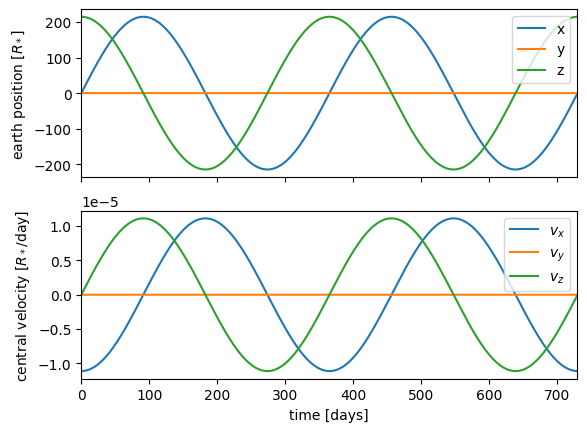
And plot the results
fig, axes = plt.subplots(2, 1, sharex=True)
ax = axes[0]
ax.plot(t, x, label="x")
ax.plot(t, y, label="y")
ax.plot(t, z, label="z")
ax.set_ylabel("earth position [$R_*$]")
ax.legend(fontsize=10, loc=1)

ax = axes[1]
ax.plot(t, vx, label="$v_x$")
ax.plot(t, vy, label="$v_y$")
ax.plot(t, vz, label="$v_z$")
ax.set_xlim(t.min(), t.max())
ax.set_xlabel("time [days]")
ax.set_ylabel("central velocity [$R_*$/day]")
_ = ax.legend(fontsize=10, loc=1)
Occultation light curve of limb darkened star#
The light_curves.limb_dark.light_curve function can be used to compute the light curve of a limb darkened star with a polynomial profile, allowing to express linear, quadratic and more complex limb darkening laws.
Using the limb darkening coefficients of the Sun from Hestroffer and Magnan we compute the flux
from jaxoplanet.light_curves.limb_dark import light_curve

u_sun = (0.30505, 1.13123, -0.78604, 0.40560, 0.02297, -0.07880)
time = jnp.linspace(-0.5, 0.5, 1000)

flux = 1.0 + light_curve(system, u_sun)(time)
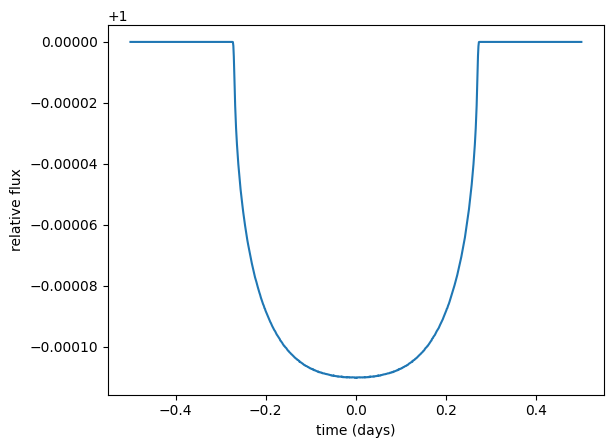
and plot the resulting light curve
plt.plot(time, flux)
plt.xlabel("time (days)")
_ = plt.ylabel("relative flux")
Non-uniform stars#
jaxoplanet aims to match the features of starry, a framework to compute the light curves of systems made of non-uniform spherical bodies.
Warning
While being stable, computing starry light curves of non-uniform surfaces is still an experimental part of jaxoplanet.
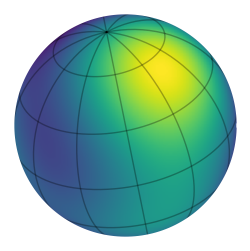
Let’s define a Surface in the spherical harmonics basis (using the Ylm object) and visualize it
import numpy as np
from jaxoplanet.starry.ylm import Ylm
from jaxoplanet.starry.surface import Surface
from jaxoplanet.starry.visualization import show_surface

np.random.seed(42)
y = Ylm.from_dense([1.00, *np.random.normal(0.0, 2e-2, size=15)])

u_star = (0.1, 0.1)
surface = Surface(inc=1.0, obl=0.2, period=27.0, u=u_star, y=y)

plt.figure(figsize=(3, 3))
show_surface(surface)
Rotational light curves#
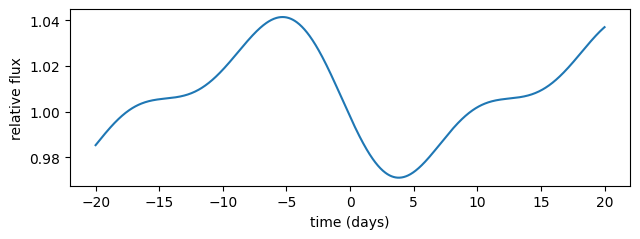
We can attach this surface to a body (like the Sun-like object we previously defined) and define a SurfaceSystem
from jaxoplanet.starry.orbit import SurfaceSystem

system = SurfaceSystem(sun, surface)
from which we compute the rotational light curve of the star
from jaxoplanet.starry.light_curves import light_curve

plt.figure(figsize=(6.5, 2.5))
time = jnp.linspace(-20, 20, 1000)
flux = light_curve(system)(time).T[0]

plt.plot(time, flux)
plt.xlabel("time (days)")
plt.ylabel("relative flux")
plt.tight_layout()
Occultation light curve#
We can add a body to the system, having its own surface
system = SurfaceSystem(sun, surface)

secondary_surface = Surface(
    y=Ylm.from_dense([1.00, *np.random.normal(0.0, 1.0, size=15)])
)

system = system.add_body(
    semimajor=(40.0 * u.au).to(u.R_sun).value,
    radius=(20.0 * u.R_earth).to(u.R_sun).value,
    mass=(1.0 * u.M_earth).to(u.M_sun).value,
    impact_param=0.2,
    surface=secondary_surface,
)
and compute the occultation light curve of the system
t_start, t_end = -20, 20
n = 1000
time = jnp.linspace(t_start, t_end, n)
flux = light_curve(system)(time).T[0]
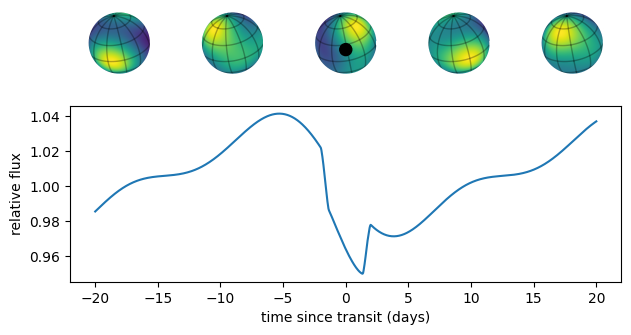
Let’s plot it and show the system over time
n_plots = 5
times = jnp.linspace(t_start, t_end, n_plots)
radius_ratio = system.bodies[0].radius / system.central.radius
gs = plt.GridSpec(2, n_plots)

plt.figure(figsize=(6.5, 4.0))

for i in range(n_plots):
    ax = plt.subplot(gs[0, i])
    phase = surface.rotational_phase(times[i])
    x, y = system.bodies[0].position(times[i])[0:2]
    show_surface(surface, ax=ax, theta=phase)
    circle = plt.Circle((x, y), radius_ratio, color="k", fill=True, zorder=10)
    ax.add_artist(circle)
    ax.set_xlim(-1.5, 1.5)

plt.subplot(gs[1, :])
plt.plot(time, flux)

plt.xlabel("time since transit (days)")
plt.ylabel("relative flux")
plt.tight_layout()